The Boy Who Cried Wolf – Why Broken Builds Must Not Be Ignored!

We’ve all heard the fable of the boy who cried wolf, an old tale written by a Greek slave who lived a long time ago and liked telling stories. I must stress thought that this was just a story, but like many good stories (Star Wars, Gremlins 2) it’s based on true events. It’s a little known fact (which I have just made up) that the story of the Boy Who Cried Wolf is actually based on an ancient Continuous Integration system (possibly belonging to Spartatech inc, a leading software development company of from around 600BCE).

The are only very sketchy records of what actually happened during this historical event, but here’s what we know for sure*:

  • The Continuous Integration system compiled code and ran unit tests.
  • The unit tests were followed by acceptance tests, which in turn were followed by integration tests.
  • The integration tests were followed by cross-platform tests.

One day, the C.I. system alerted the developers, and anyone else who would listen, that one of the builds was failing!

THE BUILD IS FAILING!!!!!!

THE BUILD IS FAILING!!!!!!

All the workers gathered around the C.I. system to take a look at the error, only to discover that in actual fact, the problem was that the machine on which the tests were running had restarted, thanks to a windows update! The developers went back to work and thought no more of it.

The very next day, the C.I. system went ballistic again, alerting the developers of yet another failure. Once again the team took notice and looked into the error. This time they discovered that the test machine was running slowly and their unit test had timed out. They restarted the machine and it all passed.

By the following week, the C.I. system had alerted the team to 5 other “failed” builds, which were simply a result of the test servers behaving oddly, and no change to the code was required at all. By the end of that week the dev team had stopped paying attention to these alerts, because they all had proper jobs to do, and a lot of work to get through by the end of the sprint (they were agile, even back then – so if you still work according to “Waterfall” THAT’S how far behind the times you are).

Then, one day, a developer checked in a piece of code which failed a unit test. The C.I. system rightly alerted the development team again, but this time nobody came running, in fact, nobody paid the blindest bit of notice. They were all so used to ignoring the C.I. system that when a real problem finally arose, it wasn’t picked up by anyone. Anyway, cutting an already long story a bit shorter, the bug was a biggie, and the next release of their software was so poor that Spartatech inc, the biggest employer in Sparta, went out of business making everyone redundant. This is what basically led to the collapse of Sparta, not sure if you knew that. And here concludes your exceedingly dodgy history lesson.

Back to the present-time: We all know that false-negatives are the enemy of a good Continuous Integration system, they lead us down a path from which it’s increasingly hard to recover. The problem is that it’s just so easy to get into that situation.  Thankfully, there are a few “Continuous Integration best practices” which we can follow, which can help us keep our system in good nick:

  • Make sure the servers on which you run your builds are cleaned regularly, preferably before every build. I would suggest a clean image be deployed each morning. This obviously means that deploying and configuring your system will need to be automatic.
  • Use tools such as VMWare, VirtualBox etc to manage your Virtual Machines.
  • Use tools like Puppet, Chef and Vagrant to automate the deployment and configuration of these VMs.
  • Add the deployment of the VMs to your C.I system!
  • If there are any randomly failing tests, which also randomly fail on your local machine, remove them or rewrite them to make them more reliable.
  • When doing sprint planning, make sure time is dedicated to investigating and fixing broken or flaky builds. It’s very important to ensure the Product and Project Managers are aware of the importance of the C.I. system, and the risk of not maintaining it properly.
  • Treat the rules of Continuous Integration as sacrosanct – if a build fails, fix it as soon as possible.

In an earlier post I wrote about the difference between having a Continuous Integration server and practicing Continuous Integration. If you start to get into the situation where you’re allowing broken builds to go un-fixed, you’re slowly slipping away from actually practicing continuous integration, and soon you’ll just be a development team who has a continuous integration server which is delivering much less value than it ought to.

*I may have got my chronology a little mixed up

Continuous Integration: The Last Mile

Conquering the Last Mile

I went to the London C.I. Meetup last week where Gus Power (how he chose a career in I.T. and not as a pro-wrestler with a name like that I do NOT know) delivered a talk entitled “C.I. The Last Mile”. Gus seems to have a comprehensive and varied background in lean and agile software engineering and delivery, and in this session he talked to us about “Conquering the last mile”, that is, getting working software out of the door.

This is NOT Gus Power

This is NOT Gus Power

We’ve all heard (or maybe even said a few times) the oft repeated mantra “but it works fine on my machine!”. This situation is commonplace, a build, for instance, will run just fine on your own PC, but as soon as it runs on the build server, it fails. Gus reminds us that, although this scenario is common, it’s a million miles away from working, releseable software, for a number of reasons, and that the only true definition of “working” software is “running, tested, and in the hands of the customer”.

Continuous Integration – is it Just a “Software” Practice?

Continuous Integration as a practice is traditionally quite a few steps removed from the world of running, tested software in the hands of the customer. In fact, Gus suggested that C.I. is usually associated with automating builds and running unit tests (although I would suggest that this is probably an increasingly naive view in this day and age, but for the sake of his talk it helped to make a point). This is obviously a long way away from delivering working software to a customer. Gus told us of his own company’s realisation that software, in their case, was not the product, and that their “product” included a lot more than just the software that the dev team delivered. He was of course referring to the supporting software and systems, and infrastructure.

Think of a web-based company, for instance Uswitch.com (for whom I used to work). While their core product may be a lot of web pages and associated content, their overall system consists of a lot more – for instance, there’s the IIS configurations, the data in the databases, the load balancers and of course the infrastructure (servers, Operating Systems etc). Note that Continuous Integration, in many cases, doesn’t cover most of this supporting system, only the company’s proprietary software (including the database in the case of Uswitch.com – at least, that was the case a few years ago when i worked there).

Gus pointed out that all these other parts of the system should also be brought under the watchful eye of Continuous Integration, and I agree with him wholeheartedly.

Lean Manufacturing

Gus went on to introduce us to the Lean Manufacturing model as used by Toyota.

Image: Toshifumi Kitamura/AFP/Getty

He said that Toyota enjoy a great deal of success due to their use of a system based on tolerances, rather than rigid specs. He seemed to suggest that this approach could be applied to some of the non-software aspects of a system, such as infrastructure.

Acceptance Criteria for Systems

I think Gus raised a particularly interesting point about the lean manufacturing system, and it made me think about how much attention we usually pay to “acceptance criteria”. In the current agile environment, much attention is focused on what constitutes “acceptance” when it comes to designing and delivering software. Many tools exist, such as Fitnesse and Cucumber, which allow us to capture acceptance criteria in relation to a user story or use case. However, while this practice is now common across many software companies, the focus tends to be on the software that’s being developed, and often doesn’t include the supporting parts of the system, such as the infrastructure (hardware, load balancers, data, etc and so forth).

cucumber - behaviour driven development with elegance and joy

Of course, there’s an obvious reason for this. Most of the stories come from user requirements, the stories are made into tasks and the tasks are worked on by the software engineers. There’s a disconnect between those responsible for delivering the software (i.e. the software engineers) and those responsible for the supporting systems (who are they anyway???). Also, the customer’s requirements are often agnostic when it comes to the supporting parts of the system – they generally don’t care about the load balancer’s capabilities, or what type of web server you use).

What we’re talking about here is the difference between “software requirements” and “system requirements”, and how the latter are quite often overlooked, or at least overshadowed by the former.

Software Acceptance vs Product Acceptance

Gus finished off his talk by recommending that all parts of your “product” (I prefer the term “system” here, but that’s just me) should be brought under the control of your C.I. system and that there should be some effort to capture and measure system acceptance criteria – here he refers back to the Toyota system of using tolerances.

I raised the subject of Chef & Puppet in the Q&A session at the end. These tools allow you to treat what are traditionally considered “infrastructure” parts of your system as code. With these tools you can easily script up and deploy VMs and Operating Systems along with their configurations,  and they also work well in a C.I. environment. Gus said that he has enjoyed some success with Chef.

This is not the chef we were referring to

This is not the chef we were referring to

Maven Assembly Plugin Filtering Part 2

We want to copy some documents, namely a releasenote.txt, into a doc directory inside the zip file that our build creates. I’m using the assembly plugin to create the zip file, and the assembly descriptor specifies the release note file to copy and filter

The tokens I’ve got in the release notes are:

  • @version@
  • @currentdate@
  • @build.number@

And I have defined the values in the pom:

<currentdate>${maven.build.timestamp}</currentdate>

<build.number>${p4.revision}</build.number>

<version>5.0.0</version>

Now, if I copy the release note using the maven resource plugin, which by default copies resources to the classes output directory, the filtering works fine. This is how I defined it in the pom:

<resources>
<resource>
<directory>src/main/resources</directory>
<filtering>true</filtering>
<includes>
<include>RELEASENOTE.txt</include>
</includes>
</resource>
</resources>

Unfortunately I don’t want to copy it to the classes directory, I want it to go in the zip assembly, in a docs directory, hence the definition in the assembly descriptor (called kit.xml). The full kit.xml can be seen at the end of this post. So, the suggested thing to do is specify the file you want to copy, and set <filtered> to true, like this:

<file>
<source>src/main/resources/RELEASENOTE.txt</source>
<outputDirectory>doc</outputDirectory>
<filtered>true</filtered>
</file>

Of course, it doesn’t work. And here’s why – unlike the maven resource plugin, the assembly plugin’s filtering doesn’t seem to work with tokens in the @bla@ format, but instead insists on using ${bla} instead. And not only that, but it won’t read my properties and values that I’ve defined in my pom either, it requires you to create a filter.properties file which defines variables/values in the style:

variable1=value1

variable2=-value2

Obviously I don’t want to do that, I’ve already got them defined in my pom and I hate duplication (think DRY principle!). So that left me with 2 options. I could explicitly define the maven resource plugin, like this:

<plugin>
        <artifactId>maven-resources-plugin</artifactId>
        <version>2.5</version>
        <executions>
          <execution>
            <id>copy-resources</id>
            <phase>prepare-package</phase>
            <goals>
              <goal>copy-resources</goal>
            </goals>
            <configuration>
              <outputDirectory>some/other/dir</outputDirectory>
              <resources>
                <resource>
                  <directory>src/main/resources</directory>
                  <filtering>true</filtering>
                </resource>
              </resources>
            </configuration>
          </execution>
        </executions>
      </plugin>

and tell it to copy my releasenote.txt file to some directory, and do the filtering on it in the process, and then bind it to a phase which happens before my assembly plugin is called (as shown above). I would then need to change my assembly descriptor to tell it where to find the new, properly filtered releasenote.txt file and copy it to the doc dir, like this:

<file>
<source>src/main/resources/RELEASENOTE.txt</source>
<outputDirectory>doc</outputDirectory>
<filtered>true</filtered>
</file>

An alternative, and this is the one I went for, is to let the maven resource filtering copy the file from src/main/resources into the target/classes directory as it does by default, and then tell the assembly descriptor to copy it from there to the doc directory:

<file>
<source>src/main/resources/RELEASENOTE.txt</source>
<outputDirectory>doc</outputDirectory>
</file>

It’s far from ideal and it’s very annoying that the maven assembly plugin does filtering differently, but in the end it gets the job done.

My full assembly descriptor, kit.xml:

<assembly>
<id>kit</id>
<formats>
<format>zip</format>
</formats>
<fileSets>
<fileSet>
<directory>src/main/resources</directory>
<outputDirectory>doc</outputDirectory>
<includes>
<include>*.*</include>
</includes>
<excludes>
<exclude>latest.properties</exclude>
<exclude>RELEASENOTE.txt</exclude>
</excludes>
</fileSet>
</fileSets>
<files>
<file>
<source>target/classes/RELEASENOTE.txt</source>
<outputDirectory>doc</outputDirectory>
<filtered>true</filtered>
</file>
<file>
<source>target/${artifactId}-${version}.${packaging}</source>
<outputDirectory>/</outputDirectory>
<destName>container-filtering-module.jar</destName>
</file>
</files>
</assembly>

Maven Release Plugin and Continuous Delivery

I was setting up a Continuous Delivery system using Maven as the build tool, Perforce as the SCM and Go (ThoughtWorks’ CI system). All was going perfectly well until I got to the point when I no longer wanted to make snapshot builds…

The idea behind my Continuous Delivery system was this:

  • Every check-in runs a load of unit tests
  • If they pass it runs a load of acceptance tests
  • If they pass we run more tests – Integration, scenario and performance tests
  • If they all pass we run a bunch of static analysis and produce pretty reports and eventually deploy the candidate to a “Release Candidate” repository where QA and other like-minded people can look at it, prod it, and eventually give it a seal of approval.

As you can see, there’s no room for the notion of “snapshot” and “release” builds being separate here. Every build is a potential release build. So, a few days ago I went right ahead and used the maven release plugin, and that was the last time I remember smiling, having fun, getting a full night’s sleep, and my brain not hurting.

The problem is this: the maven release plugin doesn’t really work for continuous delivery. And what’s more, it REALLY doesn’t work with Go and Perforce. I’ll start with the Go/Perforce issues: I got loads of errors thanks to the way Go runs as the system user, and creates its own clientspecs. The results of this debacle are detailed here and here.

I managed to finally get around the clientspec/P4/Go problems with some help from my colleague Toby Catlin who bears the scars of similar skirmishes with Go and Perforce from days gone by. The “fix” was to create a perforce config file and an “uber” client spec. The perforce config file specified the uber clientspec and it lived in the root of the project directory. It was hardly a satisfactory workaround, as it meant that every project would need to have this file, and the uber clientspec would need to be updated every time a new build job was created. But never mind that, it was just a relief to see the builds going green for a change.

And that’s when it happened… the release build completed. The maven release plugin increased the version number in the pom and checked it in. And then Go detected the change in the pom and checked it out again and started building again. This then updated the version number and checked it in, which in turn got detected and kicked off another build CAN YOU SEE THE GLARINGLY OBVIOUS PROBLEM HERE????

It’s obvious really. I’ve always made my maven release builds a manual process in the past and that was exactly why, I’d just forgotten all about it. So, I’ve decided not to use the maven release plugin at all. Every build now just creates a “release” build because I’ve removed all instances of the word SNAPSHOT from the poms. If they pass all their tests and look good enough, they’re automatically promoted to the release candidate repository. And everyone’s happy. Also, I’ve added a property to the builds which pulls in a variable from the Go system, and if that’s not present the “deploy to release candidate repository” step fails – this is to stop developers from manually creating releases – all release builds must come from the CI system.

Maven Release Plugin and Perforce Clientspecs

I’m getting a very annoying error trying to do maven release builds on our CI servers, which isn’t appearing on my local workstation. The build seems to fail because the pom file is under source control (I’m using Perforce) and so it’s read-only. However, It should check out the pom file so that it isn’t read only. Alas, that doesn’t seem top be working. Here are the errors I got initially:

[ERROR] BUILD ERROR
[INFO] ————————————————————————
[INFO] Error writing POM: C:\Program Files\Cruise Agent\pipelines\yadda\yadda\pom.xml (Access is denied)

The reason behind it appeared to be:

[ERROR] CommandLineException Exit code: 1 – Client ‘xpcruisebuildvm1-STANDARD-ALL’ can only be used from host ‘xpcruisebuildvm1’.

Command line was:p4 -d “C:\Program Files\Cruise Agent\pipelines\yadda\yadda” -p perforce.mycompany.com:1666 ed
it pom.xml
org.codehaus.plexus.util.cli.CommandLineException: Exit code: 1 – Client ‘xpcruisebuildvm1-STANDARD-ALL’ can only be used from host ‘xpcruisebuildvm1’

So the first thing I did was create a new clientspec for that machine which had all the files mapped to its c:\temp directory, and then tried to run the build again, assuming this would fix the issue but present me with a whole new problem about how to fit this all in to my CI system. However, this also failed:

[ERROR] BUILD ERROR
[INFO] ————————————————————————
[INFO] Error writing POM: C:\TEMP\yadda\pom.xml (Access is denied)

This is confusing because the clientspec I’m using does have these files in its view and therefore Maven should be able to edit them. Also, this is how I have it setup on my local workstation, and that works fine…

After a lot of trial and error I managed to make some progress. One of the issues was that the client spec had the following mapping in it:

//JavaDevelopment/main/yadda/… //XPCRUISEVM808_release/temp/yadda/…

and the root was set to C:\

This means all P4 files should sync to my C:\TEMP directory, which already existed on the machine. As expected, the sync worked fine and all files appeared in C:\TEMP\yadda.

And therein lies the rub: the client spec uses lowercase “temp”, while the windows directory was uppercase “TEMP”. As simple as that. I changed the client spec to math the filesystem and for good measure updated my release plugin version to 2.1. Problem solved (well, actually that presents me with a whole new problem because I don’t want every build agent to have different client specs, because I’m using Go, and that puts them in it’s own directory under the name of the build job. Grrrr).

POM ‘ release:prepare release’ not found in repository

I’m rather irritatingly getting this error in my maven builds at the moment, trying to setup some release builds using Go:

POM ' release:prepare release' not found in repository

One issue I have with Go is that it doesn’t natively support maven. This isn’t really much of a big deal because I can just tell it to run a custom command, and point it to the mvn shell or batch file (this could be a bit of a pain if I want my builds run on windows and/or linux but don’t want to have to define separate build jobs for each one, but I don’t, and I can’t think of any reason why I would, so that’s ok). Anyway, the issue this time is with the way I setup the build job. I used the new (in version 2.2) clicky-UI to setup the job, like telling it to run the mvn batch file, and what arguments to pass. This just seemed not to work. When I looked at the Go xml file it looked a bit like this:

<job name=”build_release”>

<tasks>

<exec command=”D:\buildTools\maven\2.2.1\bin\mvn.bat” workingdir=”yadda\yadda”>

<args>-B release:prepare release:perform</args>

</tasks>

<resources>

<resource>windows</resource>

</resources>

</job>

So I deleted it and manually edited the xml, making it look like this instead:

<job name=”build_release”>

<tasks>

<exec command=”D:\buildTools\maven\2.2.1\bin\mvn.bat” args=”-B release:prepare release:perform” workingdir=”yadda\yadda” />

</tasks>

<resources>

<resource>windows</resource>

</resources>

</job>

And this seems to have fixed it. Not very impressive at all.

Continuous Delivery using build pipelines with Jenkins and Ant

My idea of a good build system is one which will give me fast, concise, relevant feedback, but I also want it to produce a proper finished article when I’ve checked in my code. I’d like every check-in to result in a potential release candidate. Why? Well, why not?

I used to employ a system where release candidates were produced separately to my check-in builds (also known as “snapshot” builds). This encouraged people to treat snapshot builds as second rate. The main focus was on the release builds. However, if every build is a potential release build, then the focus on each build is increased. Consequently, if every build could be a potential release candidate, then I need to make sure every build goes through the most rigorous testing possible, and I would like to see a comprehensive report on the stability and design of the build before it gets released. I would also like to do all of this automatically, as I am inherently lazy, and have a facebook profile to constantly update!

This presents me with a problem: I want instant feedback on check-in builds, and to have full static analysis performed on them and yet I still want every check-in build to undergo a full suite of testing, be packaged correctly AND be deployed to our test environments. Clearly this will take a lot longer than I’m prepared to wait! The solution to this problem is to break the build process down into smaller sections.

Pipelines to the Rescue!

The concept of build pipelines has been around for a couple of years at least. It’s nothing new, but it’s not yet standard practice, which is a pity because I think it has some wonderful advantages. The concept is simple: the build as a whole is broken down into sections, such as the unit test, acceptance test, packaging, reporting and deployment phases. The pipeline phases can be executed in series or parallel, and if one phase is successful, it automatically moves on to the next phase (hence the relevance of the name “pipeline”). This means I can setup a build system where unit tests, acceptance tests and my static analysis are all run simultaneously at commit stage (if I so wish), but the next stage in the pipeline will not start unless they all pass. This means I don’t have to wait around too long for my acceptance test results or static analysis report.

Continuous Delivery

Continuous delivery has also been around for a while. I remember hearing about it in about 2006 and loving the concept. It seems to be back in the news again since the publication of “Continuous Delivery”, an excellent book from Jez Humble and David Farley. Again the concept is simple, roughly speaking it means that every build gets made available for deployment to production if it passes all the quality gates along the way. Continuous Delivery is sometimes confused with Continuous Deployment. Both follow the same basic principle, the main difference is that with Continuous Deployment it is implied that each and every successful build will be deployed to production, whereas with continuous delivery it is implied that each successful build will be made available for deployment to production. The decision of whether or not to actually deploy the finished article to the production environment is entirely up to you.

Continuous Delivery using Build Pipelines

You can have continuous delivery without using build pipelines, and you can use build pipelines without doing continuous delivery, but the fact is they seem made for each other. Here’s my example framework for a continuous delivery system using build pipelines:

I check some code in to source control – this triggers some unit tests. If these pass it notifies me, and automatically triggers my acceptance tests AND produces my code-coverage and static analysis report at the same time. If the acceptance tests all pass my system will trigger the deployment of my project to an integration environment and then invoke my integration test suite AND a regression test suite. If these pass they will trigger another deployment, this time to UAT and a performance test environment, where performance tests are kicked off. If these all pass, my system will then automatically promote my project to my release repository and send out an alert, including test results and release notes.

So, in a nutshell, my “template” pipeline will consist of the following stages:

  • Unit-tests
  • Acceptance tests
  • Code coverage and static analysis
  • Deployment to integration environment
  • Integration tests
  • Scenario/regression tests
  • Deployments to UAT and Performance test environment
  • More scenario/regression tests
  • Performance tests
  • Alerts, reports and Release Notes sent out
  • Deployment to release repository

Introducing the Tools:

Thankfully, implementing continuous delivery doesn’t require any special tools outside of the usual toolset you’d find in a normal Continuous Integration system. It’s true to say that some tools and applications lend themselves to this system better than others, but I’ll demonstrate that it can be achieved with the most common/popular tools out there.

Who’s this Jenkins person??

Jenkins is an open-source Continuous Integration application, like Hudson, CruiseControl and many others (it’s basically Hudson, or was Hudson, but isn’t Hudson any more. It’s a trifle confusing*, but it’s not important right now!). So, what is Jenkins? Well, as a CI server, it’s basically a glorified scheduler, a cron job if you like, with a swish front end. Ok, so it’s a very swish front end, but my point is that your CI server isn’t usually very complicated, in a nutshell it just executes the build scripts whenever there’s a trigger. There’s a more important aspect than just this though, and that’s the fact that Jenkins has a build pipelines plugin, which was written recently by Centrum Systems. This pipelines plugin gives us exactly what we want, a way of breaking down our builds into smaller loops, and running stages in parallel.

Ant

Ant has been possibly the most popular build scripting language for the last few years. It’s been around for a long while, and its success lies in its simplicity. Ant is an XML based scripting language tailored specifically for software build related tasks (specifically Java. Nant is the .Net version of Ant and is almost identical).

Sonar

Sonar is a quality measurement and reporting tool, which produces metrics on build quality such as unit test coverage (using Cobertura) and static analysis tools (Findbugs, PMD and Checkstyle). I like to use Sonar as it provides a very readable report and contains a great deal of useful information all in one place.

Setting up the Tools

Installing Jenkins is incredibly simple.  There’s a debian package for Operating Systems such as ubuntu, so you can install it using apt-get. For Redhat users there’s an rpm, so you can install via yum.

Alternatively, if you’re already running Tomcat v5 or above, you can simply deploy the jenkins.war to your tomcat container.

Yet another alternative, and probably the simplest way to quickly get up and running with Jenkins is to download the war and execute:

java -jar jenkins.war

This will run jenkins through it’s own Winstone servlet container.

You can also use this method for installing Jenkins on Windows, and then, once it’s up and running, you can go to “manage jenkins” and click on the option to install Jenkins as a Windows Service! There’s also a windows installer, which you can download from the Jenkins website

Ant is also fairly simple to install, however, you’ll need the java jdk installed as a pre-requisite. To install ant itself you just need to download and extract the tar, and then create the environment variable ANT_HOME (point this to the directory you unzipped Ant into). Then add ${ANT_HOME}/bin (or %ANT_HOME%/bin if you’re on Windows) to your PATH, and that’s about it.

Configuring Jenkins

One of the best things about Jenkins is the way it uses plugins, and how simple it is to get them up and running. The “Manage Jenkins” page has a”Manage Plugins” link on it, which takes you a list of all the available plugins for your Jenkins installation:

To install the build pipeline plugin, simply put a tick in the checkbox next to “build pipeline plugin” (it’s 2/3 of the way down on the list) and click “install”. It’s as simple as that.

The Project

The project I’m going to create for the purpose of this example is going to be a very simple java web application. I’m going to have a unit test and an acceptance test stage.  The build system will be written in Ant and it will compile the project and run the tests, and also deploy the build to a tomcat server. Sonar will be used for producing the reports (such as test coverage and static analysis).

The Pipelines

For the sake of simplicity, I’ve only created 6 pipeline sections, these are:

  • Unit test phase
  • Acceptance test phase
  • Deploy to test phase
  • Integration test phase
  • Sonar report phase
  • Deploy to UAT phase

The successful completion of the unit tests will initiate the acceptance tests. Once these complete, 2 pipeline stages are triggered:

  • Deployment to a test server

and

  • Production of Sonar reports.

Once the deployment to the test server has completed, the integration test pipeline phase will start. If these pass, we’ll deploy our application to our UAT environment.

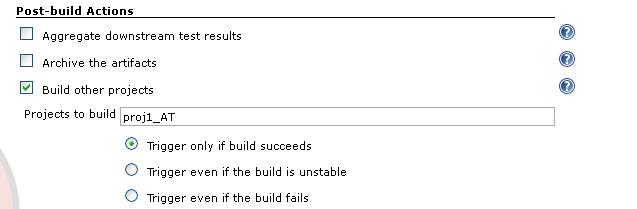
To create a pipeline in Jenkins we first have to create the build jobs. Each pipeline section represents 1 build job, which in this case runs just 1 ant task each. You have to then tell each build job about the downstream build which is must trigger, using the “build other projects” option:
Obviously I only want each pipeline section to do the single task it’s designed to do, i.e. I want the unit test section to run just the unit tests, and not the whole build. You can easily do this by targeting the exact section(s) of the build file that you want to run. For instance, in my acceptance test stage, I only want to run my acceptance tests. There’s no need to do a clean, or recompile my source code, but I do need to compile my acceptance tests and execute them, so I choose the targets “compile_ATs” and “run_ATs” which I have written in my ant script. The build job configuration page allows me to specify which targets to call:

Once the 6 build jobs are created, we need to make a new view, so that we can start to visualise this as a pipeline:

We now have a new pipeline! The next thing to do is kick it off and see it in action:

Oops! Looks like the deploy to qa has failed. It turns out to be an error in my deploy script. But what this highlights is that the sonar report is still produced in parallel with the deploy step, so we still get our build metrics! This functionality can become very useful if you have a great deal of different tests which could all be run at the same time, for instance performance tests or OS/browser-compatibility tests, which could all be running on different Operating Systems or web browsers simultaneously.

Finally, I’ve got my deploy scripts working so all my stages are looking green! I’ve also edited my pipeline view to display the results of the last 3 pipeline builds:

Alternatives

The pipelines plugin also works for Hudson, as you would expect. However, I’m not aware of such a plugin for Bamboo. Bamboo does support the concept of downstream builds, but that’s really only half the story here. The pipeline “view” in Jenkins is what really brings it all together.


“Go”, the enterprise Continuous Integration effort from ThoughtWorks not only supports pipelines, but it was pretty much designed with them in mind. Suffice to say that it works exceedingly well, in fact, I use it every day at work! On the downside though, it costs money, whereas Jenkins doesn’t.

As far as build tools/scripts/languages are concerned, this system is largely agnostic. It really doesn’t matter whether you use Ant, Nant, Gradle or Maven, they all support the functionality required to get this system up and running (namely the ability to target specific build phases). However, Maven does make hard work of this in a couple of ways – firstly because of the way Maven lifecycles work, you cannot invoke the “deploy” phase in an isolated way, it implicitly calls all the preceding phases, such as the compile and test phases. If your tests are bound to one of these phases, and they take a long time to run, then this can make your deploy seem to take a lot longer than you would expect. In this instance there’s a workaround – you can skip the tests using –DskipTests, but this doesn’t work for all the other phases which are implicitly called. Another drawback with maven is the way it uses snapshot and release builds. Ultimately we want to create a release build, but at the point of check-in we want a release build. This suggests that at some point in the pipeline we’re going to have to recompile in “release mode”, which in my book is a bad thing, because it means we have to run ALL of the tests again. The only solution I have thought of so far is to make every build a release build and simply not use snapshots.


* A footnote about the Hudson/Jenkins “thing”: It’s a little confusing because there’s still Hudson, which is owned by Oracle. The whole thing came about when there was a dispute between Oracle, the “owners” of Hudson, and Kohsuke Kawaguchi along with most of the rest of the Hudson community. The story goes that Kawaguchi moved the codebase to GitHub and Oracle didn’t like that idea, and so the split started.

Maven Assembly Plugin Filtering

A colleague at Caplin made some changes to a build pom to setup some filtering on some files. We followed the instructions given on the maven site here. It basically tells you to list the files you want to filter in your assembly descriptor, and to then list the filter and then configure your filter file inside your assembly plugin, like this:

      <plugin>

<artifactId>maven-assembly-plugin</artifactId>

<version>2.2.1</version>

<configuration>

<filters>

<filter>src/assemble/filter.properties</filter>

</filters>

<descriptors>

<descriptor>src/assemble/distribution.xml</descriptor>

</descriptors>

</configuration>

</plugin>

If you do this though, you’ll get an error saying something like:

[INFO] Error configuring: org.apache.maven.plugins:maven-assembly-plugin.

Reason: ERROR: Cannot override read-only parameter: filters in goal: assembly:single

This is basically because the Maven documentation is wrong. In reality you need to add the filters section as a child of the build element, not a child of the assembly plugin’s configuration element.

So, it should look more like this:

    <build>
<filters>
<filter>src/assemble/filter.properties</filter>
</filters>
<plugins>

<plugin>
<artifactId>maven-assembly-plugin</artifactId>
<version>2.2-beta-1</version>
<executions>
<execution>
<id>make-assembly</id>
<phase>package</phase>
<goals>
<goal>single</goal>
</goals>
<configuration>
<descriptors>
<descriptor>src/main/assembly/kit.xml</descriptor>
</descriptors>
<finalName>${pom.artifactId}-${pom.version}-${p4.revision}</finalName>
<outputDirectory>build/maven/${pom.artifactId}/target</outputDirectory>
<workDirectory>build/maven/${pom.artifactId}/target/assembly/work</workDirectory>
</configuration>
</execution>
</executions>
</plugin>

</plugins>

</build>

Automate Configuration Management Using Tokens!

Devops engineers are often tasked with the job of managing deployments of code to multiple environments. Each one may have different environmental settings such as server name/ip address, URL, subnet name and different connection settings such as db connection strings and app layer connections to name but a few. In all, there’s a truck load of differences. These differences, for convenience sake, are usually stored in config and ini files…

Usually they’re a nightmare (sorry, a challenge) to manage. But here’s a solution that has worked well for me…..

  • Use “master” config files that have ALL environmental details replaced with tokens
  • Move copies of these files to folders denoting the environments they’ll be deployed to
  • Use a token replacement operation to replace the tokens
  • Deploy over the top of your code deployments, in doing so replacing the default config files

All the above can be automated very easily, and here’s how:
First off, make tokenised copies of your config files, so that environmental values are replaced with tokens, e.g.
change things like:

<add key=”DB:Connection” value=”Server=TestServer;Initial Catalog=TestDB;User id=Adminuser;password=pa55w0rd”/ >

to

<add key=”DB:Connection” value=”Server=%DB_SERVER%;Initial Catalog=%DB_NAME%;User id=%DB_UID%;password=%DB_PWD%”/ >

Then save a copy of these tokens, and their associated values in a sed file. This sed file should contain values specific to one environment, so that you’ll end up with 1 sed file per environment. These files act as lookups for the tokens and their values.

The syntax for these sed files is:

s/%TOKEN%/TokenValue/i

So here’s the contents of a test environmemt sed file (testing.sed)

s/%DB_SERVER%/TestServer/i

s/%DB_NAME%/TestDB/i

s/%DB_UID%/Adminuser/i

s/%DB_PWD%/pa55w0rd/i

And here’s live.sed:

s/%DB_SERVER%/LiveServer/i

s/%DB_NAME%/LiveDB/i

s/%DB_UID%/Adminuser/i

s/%DB_PWD%/Livepa55w0rd/i

Next up, we want to have a section in our build script which renames the web_master.config files and copies them, and then runs the token replacement task….so here it is:

<target name=”moveconfigs” description=”renames configs, copies them to respective prep locations”>

<delete file=”${channel.dir}\web.config” verbose=”true” if=”${file::exists (webconfig)}” />

<move file=”${channel.dir}\web_Master.config” tofile=”${channel.dir}\web.config” if=”${file::exists (webMasterConfig)}” />

<delete file=”${channel.dir}\web.config” verbose=”true” if=”${file::exists (webconfig)}” />

<move file=”${channel.dir}\web_Master.config” tofile=”${channel.dir}\web.config” if=”${file::exists (webMasterConfig)}” />

<mkdir dir=”${build.ID.dir}\configs\TestArea” />

<mkdir dir=”${build.ID.dir}\configs\Live” />

<copy todir=”${build.ID.dir}\configs\TestArea\${channel.output.name}” >

<fileset basedir=”${channel.dir}” >

<include name=”**\*.config” />

<exclude name=”*.bak” />

</fileset>

</copy>

<copy todir=”${build.ID.dir}\configs\Live\${channel.output.name}” >

<fileset basedir=”${channel.dir}” >

<include name=”**\*.config” />

<exclude name=”*.bak” />

</fileset>

</copy>

</target>

<target name=”EditConfigs” description=”runs the token replacement by calling the sed script and passing the location of the tokenised configs as a parameter” >

<exec program=”D:\compiled\call_testarea.cmd” commandline=”${build.ID.dir}” />

<exec program=”D:\compiled\call_Live.cmd” commandline=”${build.ID.dir}” />

</target>

As you can see, the last target calls a couple of cmd files, the first of which looks like this:

xfind “%*\TestArea” -iname *.* |xargs sed -i -f “D:\compiled\config\testing.sed”

xfind “%*\TestArea” -iname *.* |xargs sed -i s/$/\r/

This is the sed command to read the config file, pipe the contents to sed and run the script file against it, and edit it in place. the second line handles Line Feeds so that the file ends up in a readable state. Essentially we’re telling sed to recursively read through the config file, and replace the tokens with the relevant value.

The advantage that this method has over using Nant’s “replacetokens” is that we can call the script for any number of files in any number of subdirectories using just one call, and the fact that the tokens and values are extracted from the build script. Also, the syntax means that the sed files are a lot smaller than a similar functioning Nant script would be.

And that’s about it.

Fixing java heap issue with maven sites

I’ve suddenly started getting a few java heap (OutOfMemory) errors with my maven builds, mainly when I run the mvn site phase, but also sometimes when I run sonar:sonar.

I’m running the builds on both linux (centos) and windows.

To fix the issue on Windows:

Edit mvn.bat (this lives in your maven bin directory) and add

set MAVEN_OPTS=-Xmx512m

In theory you could add an environment variable called MAVEN_OPTS and give it the same value as above (Xmx512m) but this didn’t actually work very well for me.

To fix on linux:

Edit your mvn file (which for me was in /usr/local/maven/bin/) and add:

export MAVEN_OPTS=”-Xms256m -Xmx512m”

You could of course add this to your bash profile (don’t forget to source it afterward) or add it to etc/profile, but I found adding it to the mvn file to work best.

To fix on Continuous Integration Servers:

I’ve been getting this error on a number of our CI servers as well, so rather than go around adding “export MAVEN_OPTS” all over the place, I am passing it via the CI system. Hudson, Jenkins, Bamboo and Go all have simple UIs for adding extra parameters to your build commands.